A reliable haulage quotation begins with accurate information.
The collection and delivery postcodes are important, but they are only part of the picture. To assess a transport requirement properly, a haulage company must also understand what is being moved, how large and heavy it is, when it needs to arrive and what facilities are available at each location.
Providing complete information at the beginning helps avoid delays, unsuitable vehicles and unexpected changes to the quotation.
Collection and delivery details
The first step is to provide the full collection and delivery addresses, including complete postcodes.
These allow the transport team to assess:
- The overall journey distance.
- The most appropriate route.
- Potential vehicle restrictions.
- Estimated travelling time.
- Access to both sites.
A postcode is far more useful than a town or city name alone. Two premises in the same area can have completely different access requirements.
One may be located on a large industrial estate with loading bays and turning space. Another may have a narrow entrance, controlled access or restrictions on larger commercial vehicles.
Where possible, also provide a named contact and telephone number for both locations.
A clear description of the goods
The haulage company needs to know exactly what it will be transporting.
Avoid descriptions such as “one load” or “some equipment”. Instead, provide a clear explanation, such as:
- Six wrapped pallets of manufactured components.
- Boxed retail stock.
- A piece of industrial machinery.
- Construction materials.
- Packaged engineering equipment.
The nature of the goods can influence how they are loaded, secured and transported.
You should always disclose whether the consignment is fragile, unusually shaped, particularly valuable or subject to special handling requirements.
Pallet quantity, dimensions and weight
For palletised freight, provide:
- The number of pallets.
- The length of each pallet.
- The width of each pallet.
- The overall height.
- The individual and combined weight.
- Whether the pallets can be stacked.
- Whether anything extends beyond the pallet base.
Dimensions should include the pallet, packaging and any overhang.
Accurate measurements are essential because the transport provider must select a vehicle with sufficient space and payload capacity. A load that is larger or heavier than originally declared may not be suitable for the vehicle sent to collect it.
Collection and delivery timings
Confirm when the goods will be ready and when they need to arrive.
Useful information includes:
- The earliest collection time.
- The latest collection time.
- The required delivery date.
- Any fixed booking slot.
- Whether the delivery is urgent.
- Whether the timings are flexible.
Flexibility can sometimes provide more transport options. However, if the goods must arrive within a particular window, this should be made clear from the beginning.
A next-day delivery and a flexible economy delivery will be planned differently.
Loading and unloading facilities
It is important to explain how the goods will be placed onto and removed from the vehicle.
Confirm whether each site has:
- A forklift.
- A loading bay.
- A pallet truck.
- Staff available to assist.
- Suitable access for a larger vehicle.
- A requirement for tail-lift delivery.
The facilities at the collection point may be different from those at the delivery location, so both sites should be considered separately.
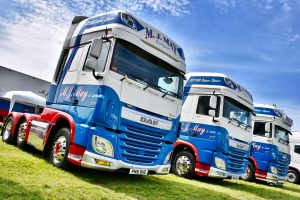
MJ May Transport operates a varied fleet and supports a range of general haulage requirements, but the correct vehicle can only be selected when the full details are known.
Access restrictions
Site access can have a significant effect on the transport arrangement.
Inform the haulage company about:
- Narrow entrances.
- Low bridges.
- Weight restrictions.
- Limited turning space.
- Security gates.
- Timed loading areas.
- Uneven ground.
- City-centre restrictions.
- Sites requiring advance registration.
Photographs can be helpful where a location has unusual access or unloading conditions.
Regular or one-off work
Make it clear whether the enquiry relates to:
- A single delivery.
- A temporary project.
- A recurring weekly movement.
- A regular route.
- Seasonal transport.
- Ongoing haulage support.
Understanding the wider requirement allows the transport provider to consider a more appropriate long-term solution rather than looking at each movement in isolation.
Requesting a quotation from MJ May Transport
When requesting a quotation, prepare:
- Collection and delivery addresses.
- The type of goods.
- Quantity.
- Dimensions.
- Weight.
- Required dates.
- Loading arrangements.
- Access information.
The more complete the information, the more accurately the transport requirement can be assessed.
To discuss a delivery, contact MJ May Transport or call the team on 01204 550330.
Frequently asked questions
Can I request a quote without knowing the exact weight?
An initial estimate may be enough to begin a conversation, but the exact weight should be confirmed before collection.
Why does the haulier need complete dimensions?
The transport team must calculate how much vehicle space the consignment will occupy and whether it can be loaded safely.
What happens if the load changes after receiving the quote?
Tell the haulage company immediately. Changes to the quantity, dimensions, weight or timing may affect the transport plan and price.